







Why Your Backyard Is the Only Gym You Actually Need
Most people overthink fitness spaces. You don’t need 2,000 square feet of rubber flooring and mirrors. You need enough room to lie flat, jump, and move laterally. That’s roughly a 10×10 foot patch of yard. I started with less.
The mental shift matters more than the square footage. When you train outside, you skip the commute, the locker room small talk, and the waiting for equipment. You just walk outside and start. That friction removal alone made me more consistent than I’d been in years. I went from three workouts a week to five, simply because the barrier dropped to almost zero.
One thing I wish I’d known earlier: uneven ground is actually a bonus. Training on grass or dirt forces your stabilizer muscles to work harder than any perfectly flat gym floor. Your ankles, knees, and core all benefit from that subtle instability.
Setting Up Your Backyard Workout Space on a Budget
Before you plan a single workout, spend 20 minutes prepping your space. Clear rocks, sticks, and anything you could land on. I learned this the hard way when I dropped into a burpee onto a pinecone. Not fun.
Also Read: Quick Summer Fitness Routines for Beach Body Prep 2026
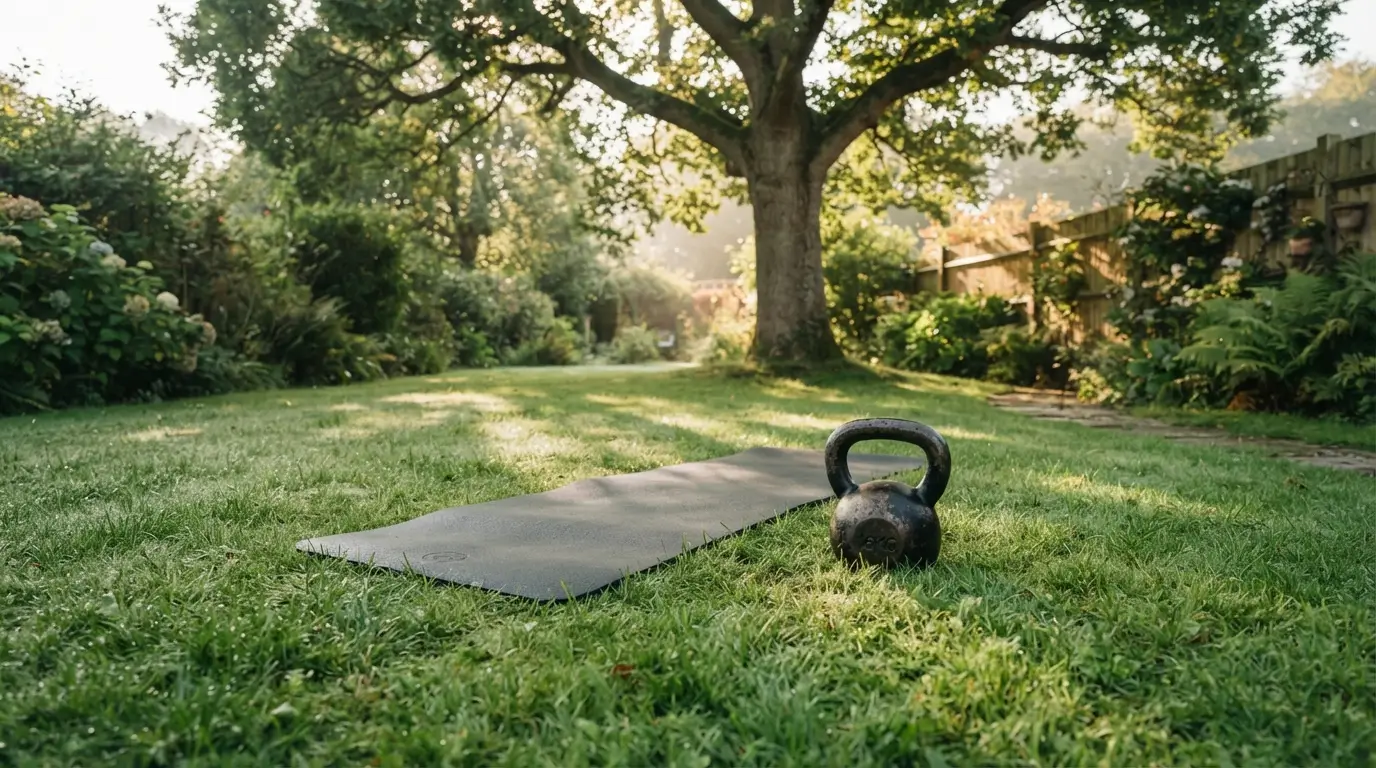
You don’t need to pour concrete or install anything permanent. A flat section of grass works perfectly. If your yard slopes, find the most level area, even if it’s small. I use a $15 outdoor mat from Walmart for exercises where my hands or back touch the ground, and that’s been enough for two full years of training.
For shade, I positioned my workout zone near a tree that blocks the afternoon sun. If you don’t have natural shade, a pop-up canopy from Amazon (around $40) works great during summer months. Heat management is a real factor when you’re training outdoors consistently.
Essential Budget Equipment That Actually Earns Its Keep
Here’s where people either overspend or skip things they genuinely need. I’ve bought plenty of backyard fitness gear. Some of it was brilliant. Some of it collects dust. Here’s what survived the test of time.
Resistance Bands ($10 to $25)
A set of loop bands from Fit Simplify or INTEY covers everything from warm-ups to heavy banded squats. I use mine in every single workout. They weigh nothing, store anywhere, and add legitimate resistance to bodyweight movements. The fabric hip bands are worth the extra few bucks over the thin latex ones, which snap after a few months.
A Jump Rope ($8 to $15)
Nothing beats a speed rope for cardio in a small space. The Buddy Lee Aero Speed is my favorite, but even a basic $8 rope from a sporting goods store works. Five minutes of jumping matches the conditioning of a much longer jog, and you never leave your yard.
A Pair of Adjustable Dumbbells or a Single Kettlebell ($30 to $80)
If you buy one piece of “real” equipment, make it a kettlebell. A 35-pound kettlebell from CAP Barbell or Yes4All handles swings, goblet squats, rows, presses, and Turkish get-ups. That single piece of iron covers full-body training for most people. I’ve had mine for two years, and it still looks brand new because, shocker, cast iron is tough.
Building Affordable Outdoor Workout Plans for Backyard Fitness Enthusiasts
Now for the actual programming. The biggest mistake I see people make is treating backyard workouts like watered-down gym sessions. They’re not. They’re a different training style, and when you lean into what makes outdoor training unique, the results come faster.
I rotate three workout templates throughout the week. Each one takes 30 to 40 minutes and requires minimal equipment.
Template 1: Strength Circuit
Pick four compound movements. Perform each for 8 to 12 reps, rest 30 seconds between exercises, rest 90 seconds after all four, then repeat for 4 rounds. My go-to combination is kettlebell goblet squats, push-up variations, banded rows anchored to a fence post, and reverse lunges. This setup hits every major muscle group, and the short rest keeps your heart rate elevated enough to burn serious calories without dedicated cardio.
Template 2: Cardio and Conditioning
Alternate 40 seconds of work with 20 seconds of rest for 20 to 25 minutes. Cycle through jump rope, high knees, squat jumps, mountain climbers, and lateral shuffles. This format, basically a Tabata-style rotation, absolutely crushes you in the best way. I usually collapse on the grass afterward and stare at the sky for a solid two minutes. It’s become a ritual.
Template 3: Mobility and Active Recovery
I dedicate one day per week to mobility work outside. Yoga flows, deep stretching, foam rolling on the mat, and slow bodyweight movements like deep squats held for 30 seconds. Doing this outdoors feels completely different than doing it indoors. The breeze, the birds, the sunshine on your skin while you hold a pigeon stretch. It actually makes you want to do mobility work, which is half the battle.
Programming Your Week for Real Progress
Having templates means nothing without a schedule. Here’s what a typical week looks like for me, and it’s held up for over a year.
Monday is Strength Circuit. Tuesday is Cardio and Conditioning. Wednesday is Mobility. Thursday is Strength Circuit with different exercise selections. Friday is Cardio and Conditioning. Saturday I do something fun, like hiking, playing basketball, or yard work that doubles as exercise. Sunday is full rest.
The key is progressive overload, even without heavy weights. Add reps. Slow down the tempo. Reduce rest periods. Use a heavier band. Elevate your feet during push-ups. Progression doesn’t require a barbell. It requires intention.
I track every workout in a $5 notebook. Nothing fancy. Just the date, exercises, reps, and how I felt. Looking back through three filled notebooks, I can see clear progress, and that visual proof keeps motivation high when January enthusiasm fades.
Handling Weather and Seasonal Challenges
Rain, cold, heat, and wind will all test your commitment. I’ve trained through all of them and here’s what actually works.
For rain, a covered patio or carport solves 90% of the problem. Light rain on warm days? I honestly enjoy it. Heavy downpours mean I move the workout indoors or swap to a bodyweight routine in the garage.
For heat, train early. I’m talking 6:30 AM before the sun gets aggressive. Keep a water bottle within arm’s reach (I use a 40oz Stanley) and cut the session short if you feel dizzy. Heat exhaustion is real and not something to push through.
For cold, layers are your friend. I wear a long-sleeve compression shirt under a hoodie and strip the hoodie off after the warm-up. Gloves matter more than you’d think, especially for kettlebell work. Cold metal at 35 degrees is genuinely painful on bare hands.
Wind is the most underrated annoyance. It makes jump rope nearly impossible and can blow your mat around. On windy days, I skip the rope and sub in high knees or running in place.

Staying Motivated Without a Gym Community
This is the part nobody talks about. Gyms provide social accountability. Your backyard doesn’t. You have to build that structure yourself.
I use two strategies. First, I text a friend my workout completion every day. Just a quick “Done, 35 min strength circuit.” That tiny bit of external accountability works surprisingly well. Second, I follow outdoor fitness accounts on Instagram, people like @sfrancofitness and @primalmovement, because watching other people train outside reminds me that this lifestyle is legitimate, not some consolation prize for people who can’t afford a gym.
Also Read: Best Winter Workout Plans for Cold Climate Residents 2026
Playing music or podcasts during workouts also helps massively. I have a JBL Clip 4 speaker that clips to my fence, and it’s survived rain, heat, and being dropped more times than I’ll admit.
Frequently Asked Questions
Can backyard workouts really build muscle without heavy weights?
Absolutely. Progressive calisthenics, resistance bands, and a single kettlebell can build serious muscle. I’ve added visible size to my shoulders and legs training exclusively outdoors. The key is progressive overload through added reps, slower tempos, and harder variations rather than heavier loads. Your muscles respond to tension, not the source of it.
What’s the minimum budget to start affordable outdoor workout plans?
You can start for under $30. A set of resistance bands, a jump rope, and an outdoor mat cover a huge range of exercises. I trained my first three months with just those items before adding a kettlebell. Don’t let the idea of expensive equipment stop you from starting today.
How do I keep my outdoor equipment from rusting or wearing out?
Store everything indoors or in a sealed bin after use. I keep a plastic deck box from Rubbermaid ($35 at Home Depot) on my patio. Wipe kettlebells dry after sweaty sessions and spray them with WD-40 every few months. Resistance bands last longer when stored out of direct sunlight.
Are outdoor workouts safe during summer heat?
They’re safe if you’re smart about timing and hydration. Train before 8 AM or after 6 PM during peak summer. Drink water before, during, and after. Wear sunscreen and light-colored clothing. If temperatures exceed 95 degrees with high humidity, move the session indoors or take a rest day. No workout is worth heat stroke.
Do I need a lot of backyard space for these workout plans?
Not at all. A 10×10 foot area handles everything I’ve described in this guide. I’ve trained in spaces even smaller when traveling. If you have room to do a burpee without hitting anything, you have enough room for a full workout. Prioritize a flat, debris-free surface over size.
Conclusion
Building affordable outdoor workout plans for backyard fitness enthusiasts changed how I think about exercise entirely. It stripped away the excuses, the expenses, and the complications, and left me with something that actually works, every single week, rain or shine. What’s stopping you from dragging a kettlebell outside and giving it a shot this weekend?